
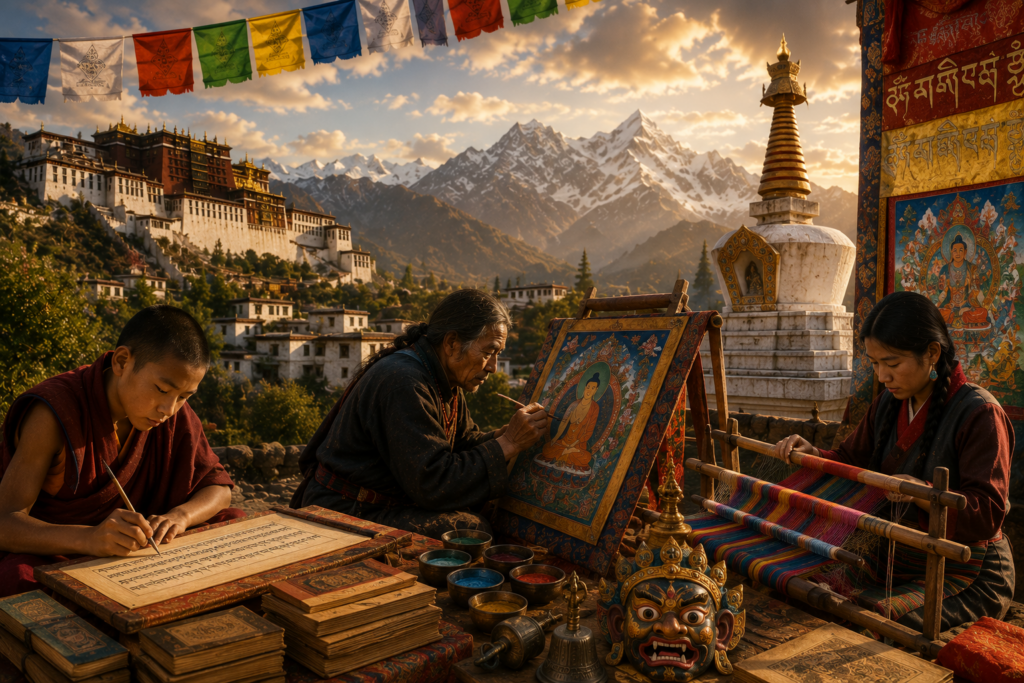
Protecting a living tradition for future generations
Tibetan culture carries a remarkable heritage of spirituality, philosophy, language, art and tradition developed and preserved across many centuries.
It is a living heritage, passed from teachers to students, parents to children and one generation to the next.
Through Preserve Tibetan Culture & Heritage, Tibetan Sakya Trust seeks to help safeguard this precious legacy so that it can continue to be studied, practised and experienced for generations to come.
PRESERVING A LIVING CULTURE
Cultural preservation is about more than protecting objects from the past.
A tradition remains alive when its language is spoken, its knowledge is taught, its arts are practised and its customs continue to have a place within everyday life.
Our support may help preserve and promote:
Tibetan Language
Supporting opportunities to learn, teach and preserve the Tibetan language for future generations.
Traditional Arts & Crafts
Helping sustain artistic traditions and skills that form part of Tibet’s rich cultural heritage.
Music, Ritual & Celebration
Supporting the continuation of traditional practices, ceremonies and cultural events.
History & Cultural Knowledge
Helping preserve records, stories, knowledge and resources that connect future generations with their heritage.
PRESERVING SACRED TEXTS & TEACHINGS
For centuries, Buddhist teachings have been carefully preserved within Tibetan culture through handwritten manuscripts, printed texts, oral transmission and dedicated study.
Protecting these teachings is an important part of preserving the wider Tibetan heritage.
The Trust may support appropriate projects involving the preservation, translation, publication and digital safeguarding of Buddhist texts and other important cultural materials.
Modern technology offers new opportunities to ensure that precious teachings and historical materials can survive and remain accessible far into the future.
BUDDHIST ART & SACRED HERITAGE
Tibetan Buddhism has given rise to an extraordinary artistic tradition.
Thangka paintings, statues, temples, stupas and other sacred objects are not simply works of art. They carry symbolism, teachings and practices that have been transmitted across generations.
Supporting traditional artists and preserving sacred heritage helps keep these skills, meanings and traditions alive.
MONASTERIES & CENTRES OF LEARNING
For centuries, Tibetan monasteries have served as places of spiritual practice, education, philosophy, art and cultural preservation.
They continue to play an important role in maintaining traditions that might otherwise disappear.
Where appropriate, Tibetan Sakya Trust may support monasteries, cultural institutions and projects working to preserve this living heritage.
A HERITAGE THAT BELONGS TO THE FUTURE
Preservation is not about keeping Tibetan culture frozen in the past.
It is about giving future generations the opportunity to inherit it.
A child learning Tibetan today may teach it to their own children decades from now.
A manuscript preserved today may still be studied centuries from now.
A traditional skill supported today may continue through another generation of artists.
What we protect now can continue to benefit people long after we are gone.
KEEPING WISDOM ALIVE
Tibetan Buddhist culture contains centuries of teachings on compassion, wisdom, meditation and the nature of the mind.
Its preservation therefore has significance beyond any single community.
By protecting Tibetan culture and heritage, we help ensure that this extraordinary tradition remains a living source of knowledge, inspiration and spiritual practice for people throughout the world.
HELP PRESERVE A PRECIOUS HERITAGE
Your support can help Tibetan Sakya Trust preserve Tibetan language, culture, sacred teachings, traditional arts and Buddhist heritage for future generations.
Every act of support helps ensure that something precious continues to live.
Together, we can honour the wisdom of the past while protecting it for the future.